
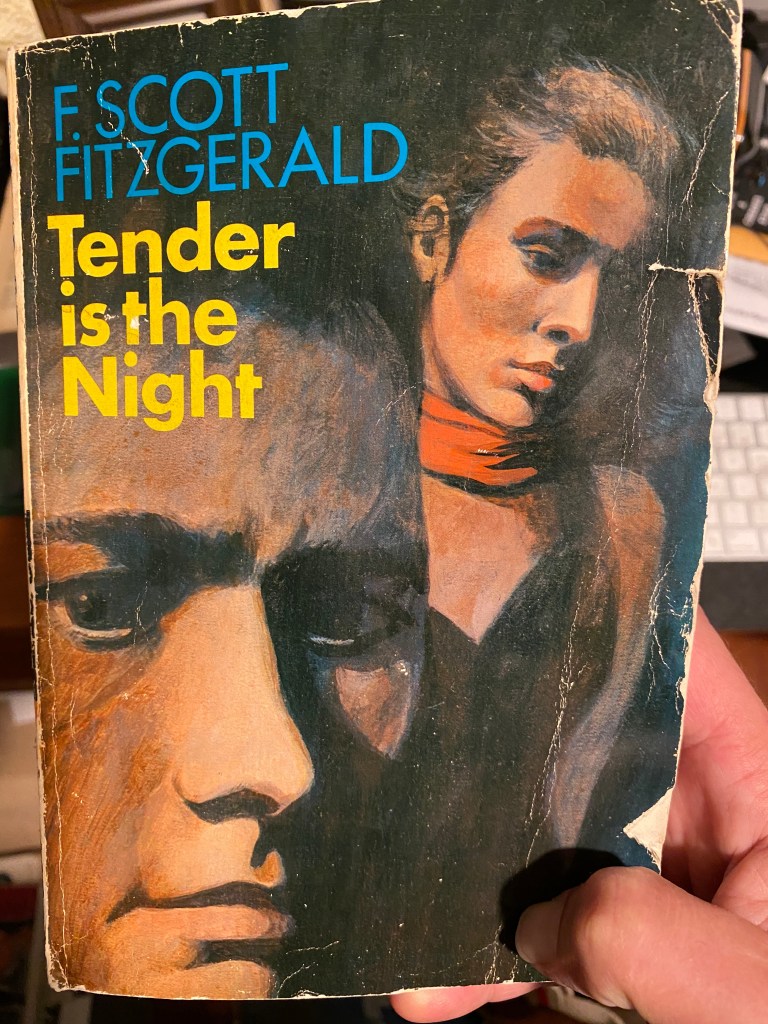
I recently read F. Scott Fitzgerald’s Tender Is the Night. I was eager to get to it after having such an outstanding experience reading his collected stories. Many of the stories that I most enjoyed were composed during the years that Fitzgerald was struggling with that novel, not to mention with his alcoholism, his wife Zelda’s mental illness, and a constant need of funds.
It is difficult to ignore the details of Fitzgerald’s life when dipping or diving into his work, or at least it is for me. It is doubly difficult to separate the facts of his life from his fiction when the material at hand is so heavily autobiographical. When we watch the main protagonist of the novel, Dick Diver, go to pieces due to excessive drinking, involvement in his wife’s therapy (he’s not only her husband, he’s in charge of her treatment!), love affairs, and self-absorption, we can’t help but think of the soap opera that was F. Scott Fitzgerald’s life.
Dick Diver was based on Lost Generation painter, aesthete, and man on the scene, Gerald Murphy, but mainly Fitzgerald himself. Perhaps the initial impression we are given of Dick, as seen through the eyes of his eventual paramour, Rosemary, is the Murphy influence, “He seemed kind and charming—his voice promised that he would take care of her, and that a little later he would open up whole new worlds for her, unroll an endless succession of magnificent possibilities”

By novel’s end, Dick is a beaten man, exhausted by alcoholism, his romantic affairs, and his relationship with his mentally ill wife, Nicole. The man who strode about so confidently on a French Riviera beach when Rosemary first met him, is five years later on that same beach, a broken man who is too weak and exhausted to perform a physical stunt that he had once performed with ease. That this humiliating episode happens in front of the now recovered Nicole, who is engaging in a hot affair with another man, as well as an older and less starry-eyed Rosemary. The existential and sexual impotence of Dick Diver (pun intended?) is complete. If the glamourous Dick of the beginning of the novel is based on Murphy, the Diver of the end of the novel is the battered Fitzgerald.
I must admit that I struggled to get through Tender is the Night. It is frequently brilliant and very moving at its conclusion—its autobiographical details make it doubly so for me—but I had to drag myself through certain sections. I think this mainly due to a sort of Fitzgerald overdose that I experienced after eight hundred fifty pages of his short stories. Sometimes you have to put that box of candies down after you’ve gorged yourself, however I didn’t in this case and as a result I didn’t give Tender Is the Night the attention it deserved.
I plan on reading more Fitzgerald shortly, but I will give Scott a short break before I dive into Gatsby and maybe the first two novels. And of course, there are the short stories that weren’t included in the gigantic collection…
 What Ken Is Reading