
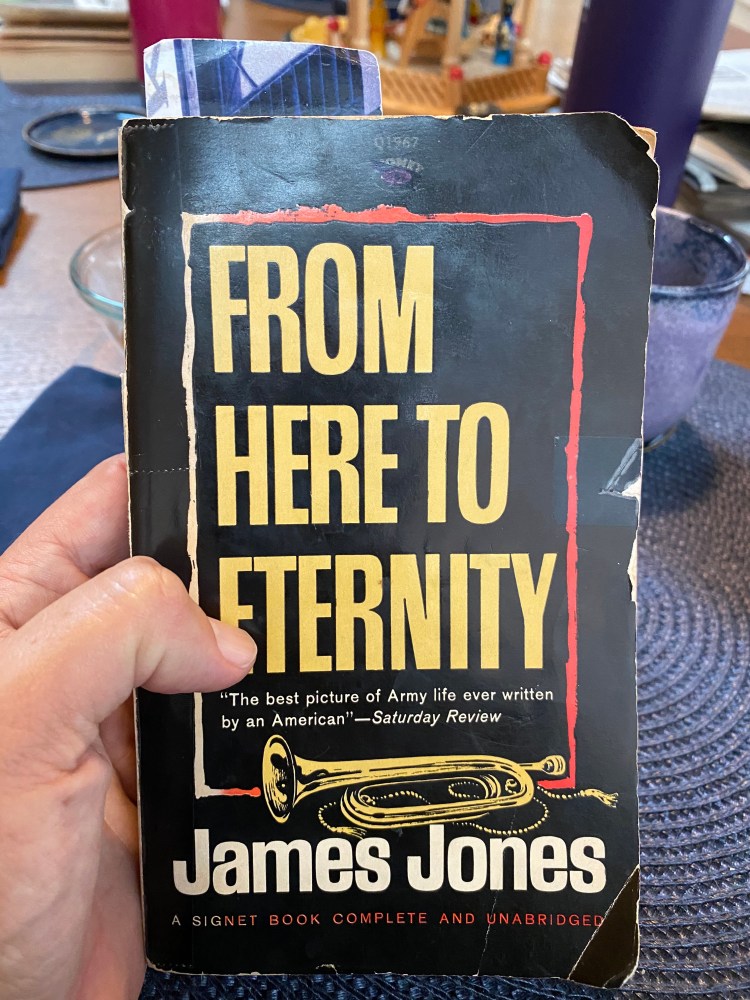
From Here to Eternity by James Jones is my first completed book of 2020. Truth be told, I began it near the end of December, but I’ll put it in this year’s column. I was inspired to read it a few months ago after I re-read Joan Didion’s essay, “In the Islands.” Near the end of this piece, Didion recounts a couple of visits to the Honolulu settings of the novel including the Schofield Barracks where Jones based the G Company of his protagonists and where he actually served and witnessed the attack on Pearl Harbor before he was shipped off to Guadalcanal (the setting of his novel, The Thin Red Line).
There is a comical and slightly tragic moment in this essay when Didion goes into a Honolulu bookstore in the days following Jones’s death. She asks a clerk if they have a copy of From Here to Eternity and is asked if it’s a bestseller, while in another she is advised by “the golden child in charge” to check the “psychic-science shelf.”
Didion’s despairing rumination over these incidents made me want to read Jones’s novel: “In that instant I thought I grieved for James Jones, a man I never met, but I think I grieved for all of us: for Jones, for myself, for the sufferers of mean guilts and for their exorcists, for Robert E. Lee Prewitt, for the Royal Hawaiian Hotel and for this golden nitwit who believed eternity to be a psychic science.”
It seems to me that after spending three and a half weeks immersed in From Here to Eternity, all eight hundred twenty pages of it, that it must be a novel that gets under the skin of its most passionate readers. But at this current moment who are these passionate fans of the novel besides Joan Didion and me?
How can I sell this novel to the socially and artistically aware reader of January, 2020? Its faults are several. It is probably at least a hundred pages too long. Its depictions of women,and especially many of its male characters’ attitudes towards women, are misogynistic; its depictions of its Chinese characters, brief though they are, are cringeworthy; it is awkwardly written in patches—man, did Jones love adverbs, including some strange, invented ones (“sillily”; “whiskily”). What’s more, it’s not a war novel featuring clear heroes and villians. Most likely, today’s reader is more likely acquainted with the 1953 film and that indelible image of Burt Lancaster and Deborah Kerr rolling around in the surf.

Adding all those things up, it’s challenging to see what value this novel might hold for the contemporary reader, and yet, at its best it captures the struggles of men and women to claim their individual humanity in a restrictive, hypocritically moralistic society on the verge of a devastating war.
When the Thomas Wolfe-worshipping Jones brought his first manuscript to famous editor (of Wolfe, Ernest Hemingway, F. Scott Fitzgerald, and many others) Max Perkins, the autobiographical novel was set aside in favor of a conversation about Jones’s life in the Army and his earlier experiences on the bum during the Depression years. “That’s the book I would like to read,” Perkins essentially told Jones, and that began its long path to publication. Perkins wouldn’t live to see that day.
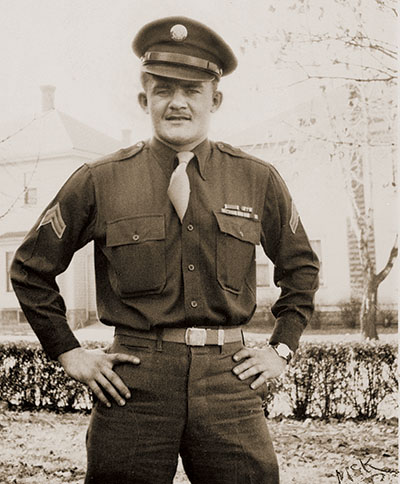
What is that I found so compelling about this book? It is the men of G Company, the nitty gritty of their daily life in the Army, the contrasting and clashing personalities of enlisted men from different backgrounds as they go about their duties, clash with the brutality of their superiors, struggle to survive on meagre pay, live for the times when they can head into the bars or brothels of Honolulu to blow off steam. Hovering over all this is the war that they know is coming–they just don’t know how directly they will be hit. But most compelling to me, is the inherent rebellion at the core of this novel. In its own way, despite the oppressive structures of the military, Hawaii is a fluid setting for these characters to break out of the strictures of traditional American moralistic strictures of gender roles, sexuality, and race. I will perhaps expand on these thoughts in the future.
Some impressions of the novel: The rebelliousness and restlessness of From Here to Eternity’s main protagonist, Robert E. Lee Prewitt and some of the rebels he encounters along the way—the crazy New York street kid, Angelo Maggio and the former Wobbly and bohemian philosopher Jack Malloy, for example— put me in mind of Jack Kerouac’s beat heroes (Jones, virtually the same age as Kerouac, did not think much of the “King of the Beats”). Jones’s matter-of-fact portrayal of homosexual relationships between some of the soldiers and gay men in Honolulu (a 2013 edition of the novel edited by Jones’s daughter, Kaylie, restored more explicit scenes of gay sex and relationships that had been removed from the original manuscript by its original publisher, Scribners) is a topic worthy of more, detailed scholarly study. In addition, despite the misogynistic attitudes of many of this novel’s male characters (and perhaps its author?), it is the two main women characters in the book, Karen Holmes, an officer’s wife who looks for love and sex outside of her cold marriage, and Alma, a young woman who uses sex work in the anonymity of Hawaii to return to the mainland with money and a new identity, who manage to achieve new social power. As Karen reflects to herself when she is leaving her husband near the end of the book, “Men were so much softer than women were.”
Above all of course From Here to Eternity is a war novel, and Jones’s most focused and vivid writing occurs when he is describing scenes of brutal violence—the hell of the stockade; a fatal knife fight; and most memorably, the Japanese aerial assault on G Company that is part of the Pearl Harbor attack. We see who the real soldiers are when the Japanese planes are strafing the compound. Milt Warden, the non-commisioned First Sergeant, who has been an efficient administrator and served as a buffer between the commissioned officers and the enlisted men, all the while conducting a hot affair with Karen Holmes, is literally cool under fire as the planes attack. He orders his men out of harm’s way while pushing aside a superior officer to get at the ammo supply to fire back at the planes. Warden’s joyous cry as he keeps his men together sums up his proficiency for battle and fitness as an officer, “All right, all right, you men. Quiet down Quiet down. It’s only a war. Ain’t you ever been in a war before?” The action, the drama, and sharpness of the details of the fire fight are exhilarating to read.
I have many more thoughts about this book that I would like to develop, but it will take another reading and more reflection, so I will save all that for another day. Highly recommended.
 What Ken Is Reading